

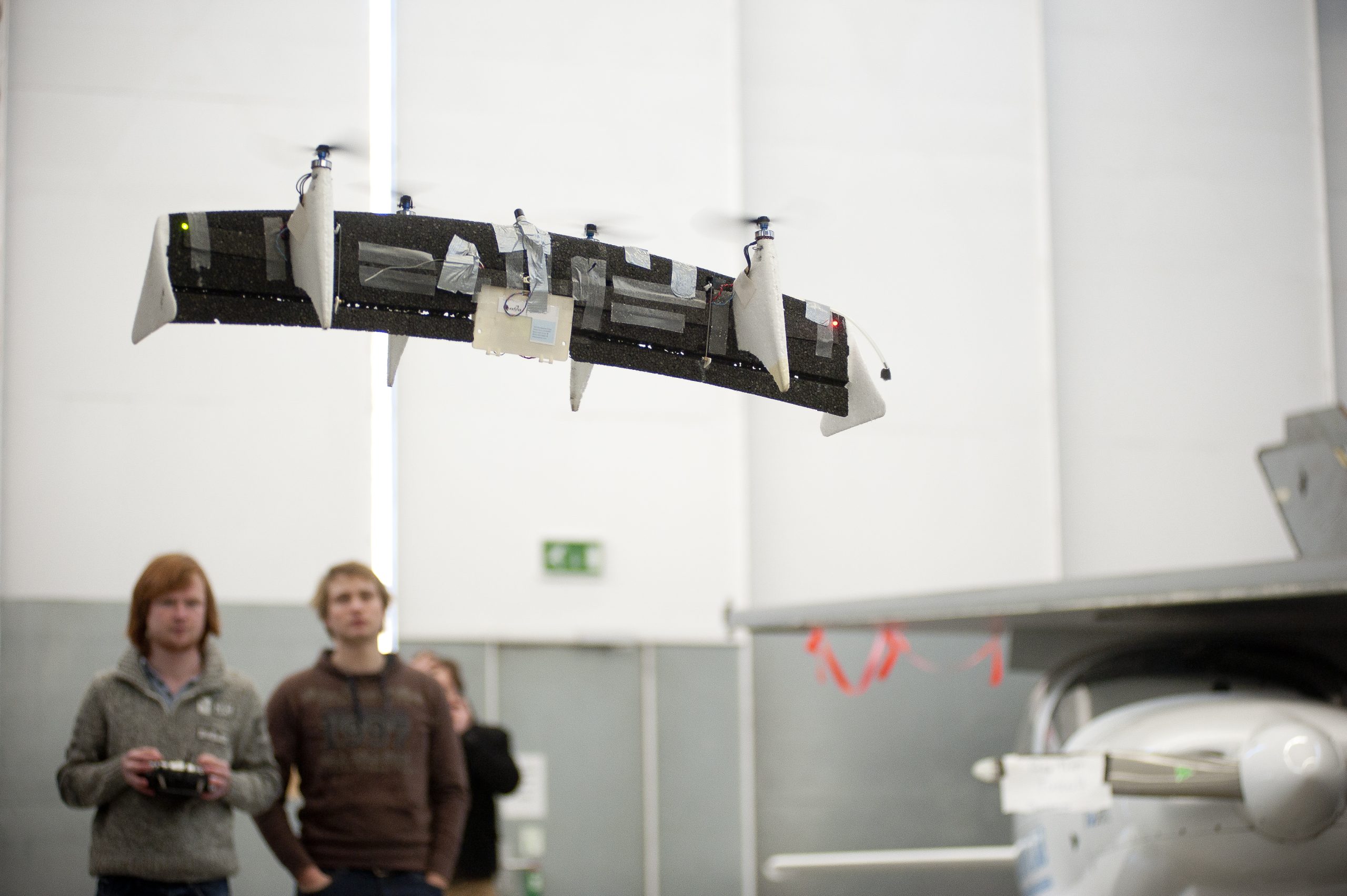
Het is nu nog allemaal een beetje houtje touwtje, maar een verbeterde – meer aerodynamische – versie van deze quadcopter (een toestel met vier motoren dat recht ophoog kan opstijgen) moet binnenkort autonoom kunnen vliegen.
Share
Bachelor-studenten van L&R hopen er in mei mee in de prijzen te vallen tijdens een wedstrijd voor autonome spionagevliegtuigen georganiseerd door Darpa, het onderzoeksinstituut van het Amerikaanse leger.
“Het vliegtuig moet drie-en-een-halve kilometer ver vliegen, vervolgens drie uur lang iets observeren –bijvoorbeeld een huis – en weer terugvliegen”, vertelt student Dieter Castelein. “Dat zijn de spelregels van Darpa.”
Het uiteindelijke ontwerp van de studenten zal meer op een vliegende vleugel lijken. “Het wordt een combinatie tussen een quadcopter en een flying wing”, zegt Castelein. “Het is echt een gadget. Net iets uit een film.”
The warning in de Volkskrant is a response to an article in the New York Times of February 26 stating that surface water in the United States contains radioactivity at levels higher than previously known.
The US newspaper got hold of thousands of internal documents from the Environmental Protection Agency. The New York Times reports that these documents reveal that wastewater is sometimes hauled to sewage plants not designed to treat it and is then discharged into rivers that supply drinking water.
The extraction of shale gas involves injecting huge amounts of water, mixed with sand and chemicals, at high pressures in order to crack open shale formations and release the gas.
In the province of North Brabant an experiment is about to start to extract this unconventional gas. Could radioactive waste water also cause problems in the Netherlands, as de Volkskrant suggests?
The main cause of the radioactivity is radium, which naturally occurs in the ground. According to geologist Professor Stefan Luthi, at the faculty of Civil Engineering and Geosciences, the rocks, especially ignition rocks like granite, in some areas of the United States contain large amounts of this element, which is a decay product of uranium or thorium. When radium subsequently decays, the radioactive gas radon is formed.
Possible risks however do not keep Prof. Luthi awake at night. He doesn’t know how much radium the Dutch ground contains, but he says the situation in the United States cannot be compared to that in the Netherlands. “The article in de Volkskrant is scare-mongering,” he charges. “There is always some radon that makes its way up through faults in the rocks. This also happens a lot in the mountains of Switzerland, but you never hear hikers complaining about it.”
Prof. Luthi also adds that the probability of shale gas being successfully extracted in the Netherlands is very low. “What they’re about to do is just an experiment. In more than 90 percent of the trials, gas and oil extraction fails. And the method will never be applied on a large scale here anyway, like it is in the United States, because shale gas is located much deeper here, the environmental rules are stricter, and the costs higher.”
Professor Bert Wolterbeek, of the Reactor Institute Delft (faculty of Applied Sciences), believes that even if significant amounts of radium do end up in wastewater, there are plenty of techniques available to retrieve it.
“It might very well be that some sewage plants in the United States were not designed to treat the radium containing water,” he says. “But this doesn’t mean that the technology is not available. You can use reverse osmosis for example or precipitation reactions.”
According to Prof. Wolterbeek this latter technique is also often used to decalcify water: “Radium much resembles calcium. If you can decalcify, you can also remove radium.”



Comments are closed.