

Co-existing with the Dutch – with their seemingly endless codes of conduct and customs – can be pretty darn challenging for foreign students. A new guidebook, ‘What?!!’, attempts to explain why the Dutch do what they do.
Share
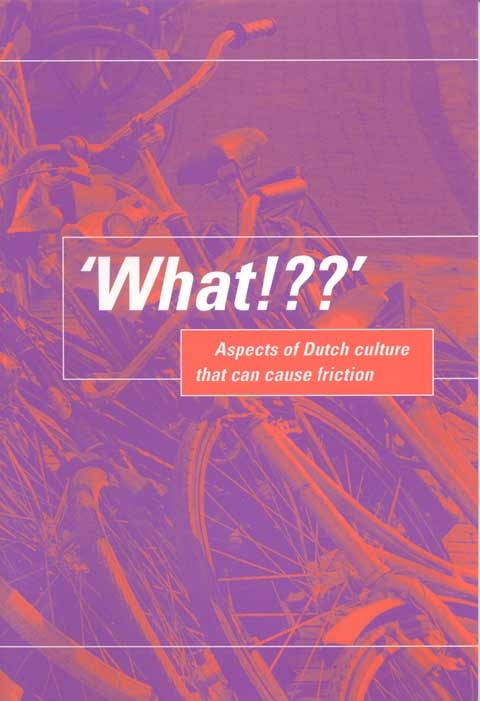
‘What?!!’, a new guidebook published by Nuffic and subtitled ‘Aspects of Dutch culture that can cause friction’, is written by an American anthropologist. And who better to write it than a scholar of human beings . don’t our Dutch hosts sometimes seem like a different species? No, of course they don’t. But sometimes they can seem pretty darn weird.
“Misunderstandings can arise between people from different countries and cultures because their expectations and their frames of reference differ as a result of different past experience,” begins Marilyn Warman, the anthropologist-author of the guidebook. No surprises there. “Without thinking about it, everyone assumes their own way of doing things is human nature,” she continues. Again, fairly obvious stuff, and the Dutch do seem to have a well laid out code of conduct that they take for granted. What?!! attempts to decipher this code and offer some insights into why Dutch people act the way they do.
The guidebook presents a series of fictional exchanges between foreign students and Dutch natives that result in both parties wondering, ‘What was that about!?’ Hence, the title. We’ve all been there. A foreign student goes into a shop, asks for help, and is then ignored by the salesperson for ten minutes. ‘Okay, the salesman is with another customer, but it will only take a minute to help me. This salesman is really rude,’ thinks the student. ‘It’s not like this in my country!’ Meanwhile, the salesperson is thinking, ‘Who does this guy think he is? How dare he interrupt me? Wait your turn, foreigner!’
What?!!, indeed! But who is right? As the saying goes, the customer is always right. If you want my money you better be nice to me, lowly salesperson! On the other hand, first come first served, that’s a fair rule, isn’t it? Who knows?
This guidebook contains lots of little helpful revelations. Did you know that, for instance, “being late is one of the easiest ways to make a Dutch person angry?” Time is very important in Dutch society. If you are late for meetings, Dutch professors could assume that you think your precious time is more valuable than theirs. But is that really what you think? Or is it just that you snoozed your alarm clock one too many times, you lazy student?
It depends on which side of the table you’re on: I am certainly angrier for being made to wait than I am sorry when I’m late. Then again, having to wait for a few minutes never killed anybody.
Obsession
Did you also know, as Warman says, that “in the ideal world of most Dutch people, everyone is equal and opportunities must be equal?” Yes, comrades, the whole of the Dutch bureaucratic system is set up to ensure that no one receives preferential treatment . and the rules in place cannot be bent or broken. This is a social ideal I can totally agree with in theory, but in practice, nobody likes dealing with the inflexible minions of bureaucracy, and their seemingly pathological obsession with ’the rules’.
Many immigrants would also not agree that the Dutch system administers opportunities equally. In many ways people are not equal, so why advancement shouldn’t be based on individual ability or achievement . survival of the fittest? Or perhaps an impartial, impersonal set of rules really is the only fair way to balance the supply and demand of limited opportunities?
Another tale of misunderstanding is as follows: foreign student signs up for outdoor excursion, wakes up on day of excursion and finds it’s raining, assumes excursion will be cancelled, and so goes back to bed. But au contraire, the excursion is most definitely not cancelled, and the student gets a call from her angry Dutch friends wondering where she is! What?!! Who is wrong here? The Dutch students who chase a lost cause, getting wet instead of canceling the trip? Or the foreign student who’s afraid of a little rain (this is Holland, what did she expect?) and who didn’t have the courtesy to at least call to say she won’t be coming?
Of course there is no absolute right or wrong in this . it’s just about the way you’ve been brought up. As Albert Einstein said, common sense is the collection of prejudices acquired by age 18. Being forced to question your preconceived ideas and assumptions is all part of living in a foreign society, and this guidebook is sure to get you thinking about the culture shock. International students should read this guidebook to understand the other, Dutch, side of the coin. Maybe Dutch students could also use it as a mirror. Then we could all argue about it. What?!!
‘What?!!: Aspects of Dutch culture that can cause friction’, by Marilyn Warman; published by Nuffic (2005); pp. 40; ISBN: 9054640405.
‘What?!!’, a new guidebook published by Nuffic and subtitled ‘Aspects of Dutch culture that can cause friction’, is written by an American anthropologist. And who better to write it than a scholar of human beings . don’t our Dutch hosts sometimes seem like a different species? No, of course they don’t. But sometimes they can seem pretty darn weird.
“Misunderstandings can arise between people from different countries and cultures because their expectations and their frames of reference differ as a result of different past experience,” begins Marilyn Warman, the anthropologist-author of the guidebook. No surprises there. “Without thinking about it, everyone assumes their own way of doing things is human nature,” she continues. Again, fairly obvious stuff, and the Dutch do seem to have a well laid out code of conduct that they take for granted. What?!! attempts to decipher this code and offer some insights into why Dutch people act the way they do.
The guidebook presents a series of fictional exchanges between foreign students and Dutch natives that result in both parties wondering, ‘What was that about!?’ Hence, the title. We’ve all been there. A foreign student goes into a shop, asks for help, and is then ignored by the salesperson for ten minutes. ‘Okay, the salesman is with another customer, but it will only take a minute to help me. This salesman is really rude,’ thinks the student. ‘It’s not like this in my country!’ Meanwhile, the salesperson is thinking, ‘Who does this guy think he is? How dare he interrupt me? Wait your turn, foreigner!’
What?!!, indeed! But who is right? As the saying goes, the customer is always right. If you want my money you better be nice to me, lowly salesperson! On the other hand, first come first served, that’s a fair rule, isn’t it? Who knows?
This guidebook contains lots of little helpful revelations. Did you know that, for instance, “being late is one of the easiest ways to make a Dutch person angry?” Time is very important in Dutch society. If you are late for meetings, Dutch professors could assume that you think your precious time is more valuable than theirs. But is that really what you think? Or is it just that you snoozed your alarm clock one too many times, you lazy student?
It depends on which side of the table you’re on: I am certainly angrier for being made to wait than I am sorry when I’m late. Then again, having to wait for a few minutes never killed anybody.
Obsession
Did you also know, as Warman says, that “in the ideal world of most Dutch people, everyone is equal and opportunities must be equal?” Yes, comrades, the whole of the Dutch bureaucratic system is set up to ensure that no one receives preferential treatment . and the rules in place cannot be bent or broken. This is a social ideal I can totally agree with in theory, but in practice, nobody likes dealing with the inflexible minions of bureaucracy, and their seemingly pathological obsession with ’the rules’.
Many immigrants would also not agree that the Dutch system administers opportunities equally. In many ways people are not equal, so why advancement shouldn’t be based on individual ability or achievement . survival of the fittest? Or perhaps an impartial, impersonal set of rules really is the only fair way to balance the supply and demand of limited opportunities?
Another tale of misunderstanding is as follows: foreign student signs up for outdoor excursion, wakes up on day of excursion and finds it’s raining, assumes excursion will be cancelled, and so goes back to bed. But au contraire, the excursion is most definitely not cancelled, and the student gets a call from her angry Dutch friends wondering where she is! What?!! Who is wrong here? The Dutch students who chase a lost cause, getting wet instead of canceling the trip? Or the foreign student who’s afraid of a little rain (this is Holland, what did she expect?) and who didn’t have the courtesy to at least call to say she won’t be coming?
Of course there is no absolute right or wrong in this . it’s just about the way you’ve been brought up. As Albert Einstein said, common sense is the collection of prejudices acquired by age 18. Being forced to question your preconceived ideas and assumptions is all part of living in a foreign society, and this guidebook is sure to get you thinking about the culture shock. International students should read this guidebook to understand the other, Dutch, side of the coin. Maybe Dutch students could also use it as a mirror. Then we could all argue about it. What?!!
‘What?!!: Aspects of Dutch culture that can cause friction’, by Marilyn Warman; published by Nuffic (2005); pp. 40; ISBN: 9054640405.



Comments are closed.