

TU Delft is a melting pot of international peoples, with thousands of students and staffers coming to Delft from hundreds of countries around the world – although not all these countries are necessarily on friendly terms.
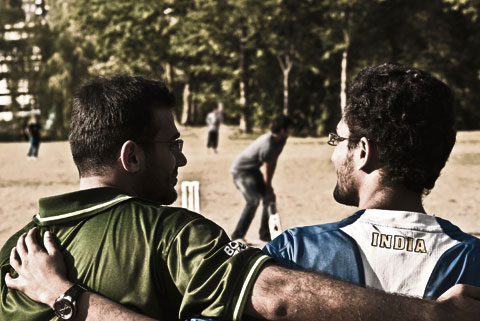
Cricket at TU Delft however is helping Indian and Pakistani students make lasting friendships on and off the pitch.
There is perhaps no single place on Earth where all neighbouring countries live completely in peace with one another. While it’s been many decades since European countries lived in hostility towards one another as preludes or interludes between wars, elsewhere in the world many countries remain openly hostile to their neighbours, engaging in long-running conflicts fuelled by political and religious differences. India-Pakistan and Israel-Palestine are but two examples.
People living in such adversarial countries often have no opportunity to interact with citizens from across the border. Yet in an international setting like TU Delft’s, these people – despite the historical conflicts festering at home – do invariably get in touch with one another in their pursuits to acquire knowledge, and often end up forming good relationships.
Since politically sensitive issues can brew trouble even in the most unexpected places, how does TU Delft regard such potential hazards among its internationals?
“Yes, we’ve thought several times about the possibility of politically sensitive issues caused by nationality,” says Elco van Noort, the head of TU Delft’s International Office. “For the next academic year we’ve received applications from more than 100 different countries – without doubt some of these countries do have not-so-friendly political relationships with others. However, for 25 years we’ve not heard about any conflict between nationalities. Sometimes there have been problems, but not related to animosity between various nationalities.”
Van Noort also ventures a guess as to why that is: “Students clearly come here to study, not for politics. We never make an issue about nationality ourselves. So as far as we know this is not an issue at all despite all the different cultures and mix.”
For many Indian and Pakistani international students, neighbours who have experienced political troubles over land sharing for the past 64 years, arriving in Delft is frequently the first time they come into contact someone from their adversarial neighbouring country. At TU Delft however these students are given a great opportunity to get along with each other in a neutral setting, offering a starting point for them to realize that human relationships are far more important than political disputes. One major factor bringing students from these two countries together is sport. Cricket, as played internationally and also now here in Delft, has become a game-changer in the souls of sub-continental students. With India’s and Pakistan’s combined populations exceeding 20% of the total world population, ‘Indo-Pak’ national cricket matches are something more than just games: they’re lifelines, remedies to fractures in society and distractions from popular inequalities and problems.
“Cricket has always been among the most watched sports in our part of the world,” says Usama Malik, a BSc aerospace engineering student from Pakistan. “People often get emotionally attached to their nation’s team and therefore consider a match as patriotic combat, which add to the level of interest and excitement.”
Cricket nonetheless has also evolved into a mature rivalry that brings people from these two countries together, as is the case at TU Delft. “I play cricket here with friends from Pakistan almost every other week,” says Ujwal Kumar, a TU Delft MSc computer science from India. “More than the cricket, I love how we can be friends with each other as opposed to popular opinion that Indians and Pakistanis cannot get along well. I hope back in our countries there is more opportunity for people to interact with friends across the border. This can indeed help reduce tensions. Sports in many ways is a better opportunity to reduce tensions than diplomacy.”
With such great importance and cultural affection attached to cricket, it’s surprising that there wasn’t an active cricket club in Delft until last year. It’s also a great surprise to many of TU Delft’s sub-continental students that a game which is followed by upwards of a billion people worldwide has little following in Netherlands. “I was taken aback when I realised that most of my Dutch friends were unaware of the existence of the Dutch national cricket team, which has been participating regularly in Cricket World Cups in recent years,” says Nishant Jain, from India. Understandably, TU Delft did not create a cricket club in the past because there was a lack of interested players. But now with increasing numbers of TU Delft international students coming from the sub-continent, which includes India, Pakistan, Sri Lanka and Bangladesh among cricket-playing nations, it was high time that such a club was formed.
Consequently, some TU Delft students sketched out plans to create a cricket club and play matches every other week. Usually an event to play over the weekend is created on the group’s Facebook page – TU Delft Cricket Club. Depending on the response, the date and times are fixed. Often more than 20 people respond, and then teams are formed and matches played against each other. On days when only a few people respond, a single team is formed and they try to arrange a match against players from the Tanthof Cricket Club. “We don’t have a group of cheerleaders or a crowd supporting us when we play, although many passers-by stop to stare at this new game being played, and usually a fielder on the boundary line helps explain the game to them,” says Ahsan Ali, a BSc aerospace engineering student from Pakistan.
The hope now among TU Delfts cricketers is that with some support from the Sports & Culture Centre, this fun, self-organised activity could become a more serious affair with official club status. Meanwhile, the team’s watch words reflect those of TU Delft’s motto for its academic education: ‘work as a team’ and ‘contribute to the team as a whole’.
Though the newly formed cricket club is still in its nascent stages, with a good push in the right direction the club hopes to grow as big as other cricket clubs in the Netherlands. More importantly, this new club gives students from two countries that have forever treated each other with animosity an opportunity to come together as friends and teammates. It is the youth of every country who determine a country’s destiny, and with great friendships developing between TU Delft’s Indian and Pakistani students on and off the pitch, the future indeed looks brighter.
Want to play or learn to play? Feel free to drop by the field opposite the TU Sports and Cultural Centre and join us for a game of cricket on weekends between 3-7 pm. Or join the TU Delft Cricket Club group on facebook for more details.
The rainfall has been extreme. Last August, more than half of the monsoon rain fell in one week, whereas typically it is spread over three months. Professor Huib de Vriend, who works both at the faculty of Civil Engineering and Geosciences and at Deltares, blames the extreme precipitation on El Nino, which in Asia tends to lead to extreme rainfall. “During the last El Nino in 1998, China was hit and the Yangtze River flooded.”
“But rainfall is not the only cause of the flood. The capacity of the Indus’ river bed has decreased enormously over the last decades.” De Vriend explains that the Indus carries water, sand and mud from the Himalayas. However, because the water has increasingly been diverted for irrigation purposes, the Indus has had too little water left to transport its sediment to the sea. The consequence has been an accelerated silting up process, making the riverbed shallower and steeper, and thus reducing its flood carrying capacity. “It’s the consequence of some 50 years of irrigation”, De Vriend explains. “This has dramatically reduced the river’s flood capacity, so that any solid downpour will now lead to higher water and flooding.”
The BBC quotes professor Rajiv Sinha, from the Indian Institute of Technology in Kanphur, who basically shares De Vriend’s interpretation. But Sinha also adds that the problem has been made worse by deforestation. The BBC writes: “Trees protect the headwaters from erosion. But over the last half century, more sediment has been flushed down the river as forests have been cut.” Professor Sinha says: “What we’ve done is apply a system from the West that just doesn’t work in South Asia.”
Meanwhile, “Dutch development workers have been involved in setting up large irrigation structures in Pakistan”, De Vriend says. “The irrigation channels run through the sand, just like the Indus. I’m therefore not surprised that local scientists are well aware of the hidden causes of the floods.”
So is there any way back? De Vriend: “You can improve the river’s properties by applying a consistent policy of not using the river for irrigation. Store rainwater instead, reduce evaporation, and better retain the water. But to do so implies reducing agriculture in favour of long term security. In a political dilemma between short term benefits and long term goals, the short term usually wins out.”
“Our understanding of why the Indus Valley is prone to catastrophic floods is steadily improving”, BBC science reporter Howard Falcon-Lang states on the website. “However, this will be of no consolation for those displaced by the worst humanitarian crisis in a decade.”



Comments are closed.