

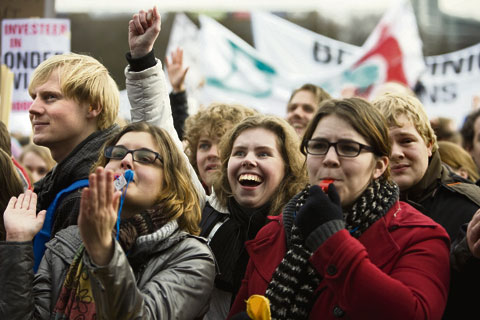
More and bigger Dutch student protests in Den Haag, but why should international students care? The student protest last Friday in Den Haag unfolded like a well-rehearsed theatre play, with the first act opening in the morning when formerly robed university professors solemnly marched through the streets in opposition to government cuts in university funding, followed by the more emotionally-charged second act in afternoon, when tens of thousands of young Dutch students gathered much more loudly – aided by megaphones, microphones and signs.
/p>
Student protests, budget cuts, government moves to force Dutch students to graduate quicker or pay ‘fines’ for extra study years have all been extensively reported in this newspaper over the past weeks. But what remained less clear is why international students should care about any of this?
In fact, one might even half-joking argue that forcing Dutch students to study harder is a good thing for international students: the libraries might become more crowded with Dutch, but the sports centres, pubs and clubs won’t be.
Kees Elsevier, a chemistry professor at the University of Amsterdam, says that while higher education budget cuts won’t directly impact the international students currently nearing the end of their studies, the cuts will impact those who’ve just started their degrees or plan to do so in future.
“Budget cuts mean fewer professors, associate professors and teachers generally at Dutch universities. Consequently, teachers will have less time to devote to international students during their studies,” Professor Elsevier explains. “Cuts also mean less equipment. For international students, there will be less time available to use what equipment there is or simply no equipment at all.”
The question then is whether Dutch universities will still be able to offer fee-paying internationals sufficient value for money? If not, fewer international students will study here, Dutch universities will generate less revenue and the university system will come under greater financial pressure.
Many of the international students at last week’s protest said they had done so to show solidarity for Dutch students and express their support for a continuing global exchange of knowledge through well-funded universities. For international students Li Chi and Chang Way, both Taiwanese PhD students in political economy at Leiden University, attending the protest was also more broadly and globally political. Should education be publically funded by governments, as in the classic European social-welfare state model, or should education be privatised and open to market forces, like neo-liberals support? “We’re here to show our disagreement with neo-liberal politics in the world,” Chi said. “Europe is an important educational stronghold for the world, so it’s important for us to be here.”
Jullie willen het gebied ‘activeren’?
“Van veraf zie je het al liggen, dat mooie weidse landschap, als je over de A13 rijdt of je fietst langs de Schie. Maar je kunt het moeilijk bereiken. Het is niet duidelijk welke paden openbaar zijn en welke naar een erf leiden waar honden op je af gestuurd worden. Wij willen er een soort beeldenpark van maken, met bankjes en meer paden.”
Scharrelpaden noemen jullie die toch?
“Ja, daar denken we aan. We willen met heel kleine ingrepen lichte recreatie in het gebied stimuleren. Je zou paden kunnen uitmaaien in het weiland. We denken ook aan openluchttheatertjes en een expositieruimte waar de historie van het gebied gepresenteerd wordt.”
Hoe is het plan ontstaan?
“Tijdens een masterproject Bouwen met Water bij Bouwkunde is het idee ontstaan om een drijvend paviljoen te maken in een vijver bij de expositieruimte World Art Delft, dat in het gebied ligt. Dat paviljoen zou met de seizoenen meedraaien. In de winter zou het paviljoen, dat aan een kant open is, met zijn open gevel naar het zuiden draaien om zoveel mogelijk licht binnen te krijgen.”
Jullie hebben gekeken hoe dat paviljoen in te passen zou zijn in andere plannen voor het gebied, en toen bleek het nogal wat voeten in de aarde te hebben om iets te veranderen in de achtertuin van de TU.
“Ja. Het bleek verschrikkelijk ingewikkeld te zijn. We hebben het plan toen breder getrokken.”
Vorige week hebben jullie het plan gepresenteerd aan een hele batterij instanties. Niets is zo ingewikkeld als landschapsontwikkeling, zei Patijn toen ironisch.
“Ja, maar het is ook wel goed dat er veel partijen over gaan, want het is heel makkelijk om het gebied met een plan te verrommelen. We hebben plannen gezien waarbij windmolens in het gebied geplaatst zouden worden; die werden ook als kunst beschouwd. Wij vinden dat de weidsheid behouden moet worden. Er hangt daar al een goede sfeer. En er zijn al wat parels in het gebied, zoals de expositieruimte World Art Delft die mee heeft gewerkt aan het plan en boer Arie die een soort zorgboerderij wil maken.”
Volgens de Delftse wethouder Saskia Bolten past jullie plan goed in het zogenaamde landschapsontwikkelingsplan dat binnenkort wordt vastgesteld.
“Het plan werd goed ontvangen. In mei organiseert het recreatieschap een workshop om er verder over te spreken. Wij begeleiden die workshop. We willen het project niet trekken, maar we willen nog wel als een soort buitenboordmotortje fungeren om het project te stimuleren.”



Comments are closed.