
TU Delft will soon become the first Dutch university to enter the virtual world of Second Life, joining other prestigious virtual universities like Harvard and MIT there.
Share
But unlike these other universities, TU Delft intends to use its virtual self to not only provide educational services, but also to contribute to the further development of this and other virtual worlds.
Second Life (SL) is different. It’s not a game, like World of Warcraft. In Second Life, there are no predefined objectives for users to attain, no beginnings and end destinations or winners and losers. SL is currently the virtual world that is closest to the real world: just like in real life, in SL you can go dancing, shopping and conduct business.
There are nevertheless some important differences. The laws of physics don’t necessarily apply in SL, where you can fly or teleport yourself from one corner of the world to another. And perhaps most intriguingly, in SL you can change your appearance, and create your own alter ego, or so-called ‘avatar’, with wings included if you like.
For TU Delft, however, it’s not these features that make this virtual world so interesting. “The possibilities of exploring SL’s educational uses, communicative opportunities, marketing power and abilities to support research practices are what interests TU Delft,” says Rob Speekenbrink, TU Delft’s Internet manager. But the TU’s not solely interested in SL. “We not only want to investigate the possibilities of this particular virtual world, but virtual worlds generally.”
SL is big business for many public and private organizations, and also for universities. Foremostly, SL makes it easier for the private and public sectors to reach their customers, offering significant opportunities for these sectors to market their products relatively cheaply to SL’s user base of more than 9 million people.
For universities, SL offers the opportunity to experiment with all kinds of educational and research activities. Unlike many other distance learning programs, in SL, students and professors . in their avatar appearances . can have ‘face-to-face’ discussions and socialize. And by not necessarily obeying the laws of nature, virtual worlds generally provide an interesting experimental environment for universities and research institutes. In SL, for example, there is no nuclear radiation or nuclear fallout.
Floating city
Last spring, TU Delft purchased two islands in SL. These islands, currently under development, are scheduled to be open to the public next month. One island is called ‘NextInfra’, the other ‘TUDelft’. ‘NextInfr’ is the SL island run by the TPM Faculty’s Next Generation Infrastructure (NGI) program. Speekenbrink: “The NGI program wanted to have a SL island to disseminate findings about their program. The TU’s marketing department was also interested in buying an island in SL to promote university-wide activities, for which we have built the ‘TUDelft’ campus.”
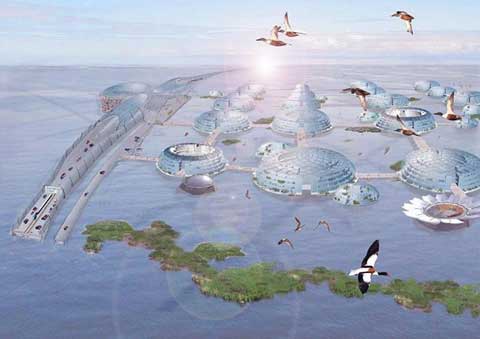
The ‘floating city’ architectural concept was chosen for both TU Delft islands and features sustainability as a guiding principle. “Basically, it’s a depiction of what a city built on water would look like,” Speekenbrink says, while emphasizing that the concept isn’t some futuristic unrealistic endeavor. “It’s really feasible to actually attempt building such a city with current technologies.”
The floating city concept was chosen because it’s both functional and pragmatic. Speekenbrink says the concept is “very exemplary” of the things TU Delft does. This concept also saves the builders from facing the restrictions and problems that would result from building the actual campus in a virtual world. “If you tried to recreate the actual campus in SL, it wouldn’t look realistic enough and people would miss certain elements. And by simply trying to recreate reality, we wouldn’t make optimal use of the virtual environment. With the floating city concept, we’re much more flexible in depicting the things we want.”
Import routines
While building the two TU islands, the university’s SL working group ran into a problem: although all kinds of objects can be built in SL, the resulting images are rather primitive. SL provides an ‘offline builder’ for importing objects from design programs like Autodesk Maya and 3Dstudio, but this offline builder isn’t able to convert complex or existing models into SL. However, SL working group team member Bart Roeffen has since written an import function that allows all technically drawn objects, like buildings or cars, to be converted in one go from Maya into SL.
Speekenbrink: “We tried building the floating city from scratch using the offline builder, but because of its rather primitive nature, the floating city looked really ugly. By using the import function we developed, we’re able to create a much nicer looking floating city.”
The SL working group is currently working on the development of software called ‘import routines’, which will allow objects to be imported from 3D-Max and AutoCAD. Speekenbrink: “Currently this isn’t possible. Everything must be built from scratch. But with these import routines, it should be a easier to get objects from these tools into SL.”
With such activities in virtual worlds like SL, TU Delft hopes to steadily close the gap between the virtual and real worlds. Speekenbrink: “Our main future objective is to create an environment that really makes a difference, an environment that’s highly interactive and really useful for its users, with a clear purpose and coherency. Basically, our aim is to set a new standard in virtual worlds.”
Working model of TU Delft’s SL ‘floating city’
Second Life (SL) is different. It’s not a game, like World of Warcraft. In Second Life, there are no predefined objectives for users to attain, no beginnings and end destinations or winners and losers. SL is currently the virtual world that is closest to the real world: just like in real life, in SL you can go dancing, shopping and conduct business.
There are nevertheless some important differences. The laws of physics don’t necessarily apply in SL, where you can fly or teleport yourself from one corner of the world to another. And perhaps most intriguingly, in SL you can change your appearance, and create your own alter ego, or so-called ‘avatar’, with wings included if you like.
For TU Delft, however, it’s not these features that make this virtual world so interesting. “The possibilities of exploring SL’s educational uses, communicative opportunities, marketing power and abilities to support research practices are what interests TU Delft,” says Rob Speekenbrink, TU Delft’s Internet manager. But the TU’s not solely interested in SL. “We not only want to investigate the possibilities of this particular virtual world, but virtual worlds generally.”
SL is big business for many public and private organizations, and also for universities. Foremostly, SL makes it easier for the private and public sectors to reach their customers, offering significant opportunities for these sectors to market their products relatively cheaply to SL’s user base of more than 9 million people.
For universities, SL offers the opportunity to experiment with all kinds of educational and research activities. Unlike many other distance learning programs, in SL, students and professors . in their avatar appearances . can have ‘face-to-face’ discussions and socialize. And by not necessarily obeying the laws of nature, virtual worlds generally provide an interesting experimental environment for universities and research institutes. In SL, for example, there is no nuclear radiation or nuclear fallout.
Floating city
Last spring, TU Delft purchased two islands in SL. These islands, currently under development, are scheduled to be open to the public next month. One island is called ‘NextInfra’, the other ‘TUDelft’. ‘NextInfr’ is the SL island run by the TPM Faculty’s Next Generation Infrastructure (NGI) program. Speekenbrink: “The NGI program wanted to have a SL island to disseminate findings about their program. The TU’s marketing department was also interested in buying an island in SL to promote university-wide activities, for which we have built the ‘TUDelft’ campus.”
The ‘floating city’ architectural concept was chosen for both TU Delft islands and features sustainability as a guiding principle. “Basically, it’s a depiction of what a city built on water would look like,” Speekenbrink says, while emphasizing that the concept isn’t some futuristic unrealistic endeavor. “It’s really feasible to actually attempt building such a city with current technologies.”
The floating city concept was chosen because it’s both functional and pragmatic. Speekenbrink says the concept is “very exemplary” of the things TU Delft does. This concept also saves the builders from facing the restrictions and problems that would result from building the actual campus in a virtual world. “If you tried to recreate the actual campus in SL, it wouldn’t look realistic enough and people would miss certain elements. And by simply trying to recreate reality, we wouldn’t make optimal use of the virtual environment. With the floating city concept, we’re much more flexible in depicting the things we want.”
Import routines
While building the two TU islands, the university’s SL working group ran into a problem: although all kinds of objects can be built in SL, the resulting images are rather primitive. SL provides an ‘offline builder’ for importing objects from design programs like Autodesk Maya and 3Dstudio, but this offline builder isn’t able to convert complex or existing models into SL. However, SL working group team member Bart Roeffen has since written an import function that allows all technically drawn objects, like buildings or cars, to be converted in one go from Maya into SL.
Speekenbrink: “We tried building the floating city from scratch using the offline builder, but because of its rather primitive nature, the floating city looked really ugly. By using the import function we developed, we’re able to create a much nicer looking floating city.”
The SL working group is currently working on the development of software called ‘import routines’, which will allow objects to be imported from 3D-Max and AutoCAD. Speekenbrink: “Currently this isn’t possible. Everything must be built from scratch. But with these import routines, it should be a easier to get objects from these tools into SL.”
With such activities in virtual worlds like SL, TU Delft hopes to steadily close the gap between the virtual and real worlds. Speekenbrink: “Our main future objective is to create an environment that really makes a difference, an environment that’s highly interactive and really useful for its users, with a clear purpose and coherency. Basically, our aim is to set a new standard in virtual worlds.”
Working model of TU Delft’s SL ‘floating city’



Comments are closed.