

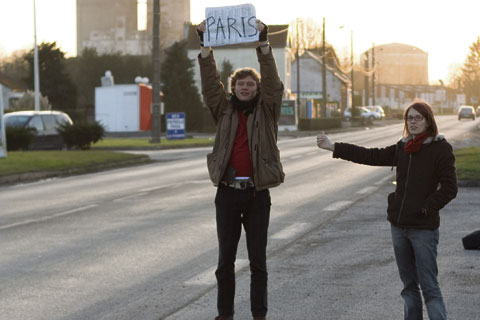
Whether sticking out a human or digital thumb, hitchhiking and ridesharing are two ways of getting around Holland and Europe cheaply, while also helping to reduce CO2 emissions.
No matter where you are or what you’re studying, money is always tight for students – and especially for international students, who, unlike their Dutch counterparts, aren’t given the OV cards that allow for free travel on Dutch public transport. And since international students in Holland aren’t likely to be given OV cards anytime soon, hitchhiking and ride-sharing are ways that some international students use to travel inexpensively, while also more importantly helping to reduce CO2 emissions per capita and, basically, helping to save our world.
Hitchhiking among Dutch students used to be fairly common. Back in the 1970s and 80s, many Dutch students not only hitchhiked within the country, but also around Europe. And how does this writer – an international student from Western Siberia – know this, you might ask? Well, mainly because many of his rides are from middle-aged Dutchmen who hitchhiked back in their student days and now return the favor by giving this poor student a lift.
Hitchhiking however is not something one recommends as such, for it’s always an entirely personal decision, dependent on many variables, like where (what country) one is contemplating hitching a ride, but nonetheless, the Netherlands is an amenable place for it, owing to various factors, like traffic congestion (lots of cars!), short geographical distances and the liberal, open-minded attitudes of the Dutch generally.
Delft moreover, given its central location, is a good place to hitch to and from, as main roads going north (Amsterdam: A4), south (Rotterdam and beyond: A13), east (Utrecht: A13-A4-A12) and west (Den Haag: A13-A12), pass by here. The best starting point for hitching is one close to an entry road to a main highway, where there is also a pullover lane or zone for drivers to stop and park. The best times to hitchhike: mornings and afternoons. Night time is the wrong time. Weekend afternoons, when parents are travelling with cars full of kids, is also not a good time to catch a ride. Weather conditions however don’t matter all that much, except for hard rain, when one wouldn’t want to be standing beside a road anyway.
While hitchhiking is not for everyone, hitchhiking in the form of ridesharing has rapidly moved into the digital age. Today, ridesharing services are popping up everywhere, offering rides in all directions, and one of the most popular is PickupPal.com, a website launched last year that coordinates ridesharing for its 140,000 members in some 110 countries around the world, including the Netherlands.
PickupPal’s ridesharing services are similar to ‘real’ hitchhiking, except that it’s a digital thumb you stick out. Ridesharing allows people to name their destination online and then be matched to others heading in the same direction. Perusing the Netherlands section of PickupPal’s site this week, a member could for example have shared a ride with ‘Driver: Bart J: Driving from Leiden, Zuid-Holland, NL to Haarlemmermeer, Noord-Holland, NL, Mon 28 Sept (a.m.)’. The site also provides customised ridesharing services, like for music fans heading to the same festivals or sports fans to the same sporting events.
Whether hitchhiking traditionally or digitally in the form of ridesharing, an added bonus for those who do it is that they’re minimising their carbon footprints, which is why PickupPal’s site boasts of ‘38,014,401 lbs of potential CO2 avoided by PickupPal’, under the site’s slogan: ‘Saving money and the environment at the same time’.
Given TU Delft’s university-wide commitment to sustainability, a worthy future agenda point for Aegee, Oras or WIS would surely be to start a university ridesharing service that not only benefits the environment and students’ wallets, but also helps promote integration between Dutch and international students.
Such a ridesharing service could easily be run via TU Delft’s blackboard. Not only do TU Delft staff members come from cities all over Holland to teach here every day, but many Dutch TU students have cars. A Dutch student heading home to Limburg for the weekend to visit his parents could, for example, post – ‘Driver: Bart J’ style – on the blackboard and then take a few international students along for the ride.
For many international students, a weekend (plus cheap hotel) in Maastricht is affordable, but not when the 50 euro train ticket to get there is also factored in. And who knows, that Dutch student might just return to Delft with a few new foreign friends – or integrated, in TU-speak.
,Evolving mobility
Whether as a way of saving money or helping to reduce one’s carbon footprint, or both, hitchhiking and roadsharing systems and sites are gaining traction in the digital age. In Belgium, a foundation called Myoto runs a scheme that features special cards for hitchhikers, allowing drivers to easily recognize hitchhikers as Myoto members. Myoto’s slogan is ‘mobile by mobile (telephone)’, backed by their claim that: ‘Hitchhiking (secured by sms) definitely deserves its place amongst the actual offer in mobility’. Myoto however isn’t a ridesharing platform, but rather ‘hitchhiking with an add-on for security’, as members whereabouts are tracked by sms. People who sign up receive a Myoto-card, which they show to drivers when standing beside the road hitchhiking. Before getting in a car, Myoto members sms the car’s license plate number to the company, and thus, as the website proclaims, ‘Myoto keeps track of you’. Meanwhile, hitchhikers.org, a seemingly Netherlands-based organization, offers opportunities to share rides to places all over Europe, with many of the listed rideshares originating in the Netherlands. So, for example, if you’re looking for something to do on October 2, you could share a ride with someone from ‘Netherlands (Utrecht) to Switzerland (Bern)’. The site asks: ‘Drivers with empty spaces in their cars and in need of some laughing, a serious conversation or a (small) compensation, please click here for submitting a ride!’
Elsewhere, using new cell phone technology, a company called Avego is behind a multi-million dollar initiative to create a huge network of personal taxis. The company recently launched a tool to connect drivers with passengers via a new web- and phone-based carpooling service. Essentially, drivers sell seats in their cars to riders willing to pay. Would-be passengers call an automated operator and state their desired destination. Drivers in the area then receive a message that there’s someone in the area looking (to pay) for a ride. The service, which works with regular cell phones and also via a free, downloadable Apple iPhone application, is run through PayPal. Avego keeps track of how far a driver carried a passenger, while the passenger’s PayPal account is then debited for the trip. The driver is then compensated for the ride. Avego’s chairman, Sean O’Sullivan, estimates that a driver could earn as much as $3,000 per year selling empty seats in his/her car. The system is currently in use in Dublin and San Francisco.
hitchikers.org
myoto.be
avego.com
Tweeduizend Harvard-studenten zouden op 20 januari een tentamen moeten maken van 9.15 tot 12.15 uur, terwijl Obama om exact twaalf uur ’s middags de presidentiële eed aflegt. Zeshonderd studenten pikten het niet en ondertekenden een petitie waarin ze vroegen om een inhaaltentamen, zodat ze deze historische gebeurtenis op televisie konden volgen.
Harvard streek over zijn hart en sloot een compromis met de studentenraad. De toets begint nu driekwartier eerder, om half negen, zodat de studenten op tijd klaar zijn. Maar ja, dat betekent vroeg opstaan.
“Erg frustrerend, want dit is niet waar we om vroegen”, klaagt een student in universiteitskrant The Harvard Crimson. “Nu moeten alle studenten vroeg wakker worden, zelfs als ze niet zoveel om de inauguratie geven.” Bovendien waren sommige studenten van plan voor deze gelegenheid naar Washington te gaan en die hebben niets aan het compromis.
No matter where you are or what you’re studying, money is always tight for students – and especially for international students, who, unlike their Dutch counterparts, aren’t given the OV cards that allow for free travel on Dutch public transport. And since international students in Holland aren’t likely to be given OV cards anytime soon, hitchhiking and ride-sharing are ways that some international students use to travel inexpensively, while also more importantly helping to reduce CO2 emissions per capita and, basically, helping to save our world.
Hitchhiking among Dutch students used to be fairly common. Back in the 1970s and 80s, many Dutch students not only hitchhiked within the country, but also around Europe. And how does this writer – an international student from Western Siberia – know this, you might ask? Well, mainly because many of his rides are from middle-aged Dutchmen who hitchhiked back in their student days and now return the favor by giving this poor student a lift.
Hitchhiking however is not something one recommends as such, for it’s always an entirely personal decision, dependent on many variables, like where (what country) one is contemplating hitching a ride, but nonetheless, the Netherlands is an amenable place for it, owing to various factors, like traffic congestion (lots of cars!), short geographical distances and the liberal, open-minded attitudes of the Dutch generally.
Delft moreover, given its central location, is a good place to hitch to and from, as main roads going north (Amsterdam: A4), south (Rotterdam and beyond: A13), east (Utrecht: A13-A4-A12) and west (Den Haag: A13-A12), pass by here. The best starting point for hitching is one close to an entry road to a main highway, where there is also a pullover lane or zone for drivers to stop and park. The best times to hitchhike: mornings and afternoons. Night time is the wrong time. Weekend afternoons, when parents are travelling with cars full of kids, is also not a good time to catch a ride. Weather conditions however don’t matter all that much, except for hard rain, when one wouldn’t want to be standing beside a road anyway.
While hitchhiking is not for everyone, hitchhiking in the form of ridesharing has rapidly moved into the digital age. Today, ridesharing services are popping up everywhere, offering rides in all directions, and one of the most popular is PickupPal.com, a website launched last year that coordinates ridesharing for its 140,000 members in some 110 countries around the world, including the Netherlands.
PickupPal’s ridesharing services are similar to ‘real’ hitchhiking, except that it’s a digital thumb you stick out. Ridesharing allows people to name their destination online and then be matched to others heading in the same direction. Perusing the Netherlands section of PickupPal’s site this week, a member could for example have shared a ride with ‘Driver: Bart J: Driving from Leiden, Zuid-Holland, NL to Haarlemmermeer, Noord-Holland, NL, Mon 28 Sept (a.m.)’. The site also provides customised ridesharing services, like for music fans heading to the same festivals or sports fans to the same sporting events.
Whether hitchhiking traditionally or digitally in the form of ridesharing, an added bonus for those who do it is that they’re minimising their carbon footprints, which is why PickupPal’s site boasts of ‘38,014,401 lbs of potential CO2 avoided by PickupPal’, under the site’s slogan: ‘Saving money and the environment at the same time’.
Given TU Delft’s university-wide commitment to sustainability, a worthy future agenda point for Aegee, Oras or WIS would surely be to start a university ridesharing service that not only benefits the environment and students’ wallets, but also helps promote integration between Dutch and international students.
Such a ridesharing service could easily be run via TU Delft’s blackboard. Not only do TU Delft staff members come from cities all over Holland to teach here every day, but many Dutch TU students have cars. A Dutch student heading home to Limburg for the weekend to visit his parents could, for example, post – ‘Driver: Bart J’ style – on the blackboard and then take a few international students along for the ride.
For many international students, a weekend (plus cheap hotel) in Maastricht is affordable, but not when the 50 euro train ticket to get there is also factored in. And who knows, that Dutch student might just return to Delft with a few new foreign friends – or integrated, in TU-speak.
Evolving mobility
Whether as a way of saving money or helping to reduce one’s carbon footprint, or both, hitchhiking and roadsharing systems and sites are gaining traction in the digital age. In Belgium, a foundation called Myoto runs a scheme that features special cards for hitchhikers, allowing drivers to easily recognize hitchhikers as Myoto members. Myoto’s slogan is ‘mobile by mobile (telephone)’, backed by their claim that: ‘Hitchhiking (secured by sms) definitely deserves its place amongst the actual offer in mobility’. Myoto however isn’t a ridesharing platform, but rather ‘hitchhiking with an add-on for security’, as members whereabouts are tracked by sms. People who sign up receive a Myoto-card, which they show to drivers when standing beside the road hitchhiking. Before getting in a car, Myoto members sms the car’s license plate number to the company, and thus, as the website proclaims, ‘Myoto keeps track of you’. Meanwhile, hitchhikers.org, a seemingly Netherlands-based organization, offers opportunities to share rides to places all over Europe, with many of the listed rideshares originating in the Netherlands. So, for example, if you’re looking for something to do on October 2, you could share a ride with someone from ‘Netherlands (Utrecht) to Switzerland (Bern)’. The site asks: ‘Drivers with empty spaces in their cars and in need of some laughing, a serious conversation or a (small) compensation, please click here for submitting a ride!’
Elsewhere, using new cell phone technology, a company called Avego is behind a multi-million dollar initiative to create a huge network of personal taxis. The company recently launched a tool to connect drivers with passengers via a new web- and phone-based carpooling service. Essentially, drivers sell seats in their cars to riders willing to pay. Would-be passengers call an automated operator and state their desired destination. Drivers in the area then receive a message that there’s someone in the area looking (to pay) for a ride. The service, which works with regular cell phones and also via a free, downloadable Apple iPhone application, is run through PayPal. Avego keeps track of how far a driver carried a passenger, while the passenger’s PayPal account is then debited for the trip. The driver is then compensated for the ride. Avego’s chairman, Sean O’Sullivan, estimates that a driver could earn as much as $3,000 per year selling empty seats in his/her car. The system is currently in use in Dublin and San Francisco.

Do you have a question or comment about this article?
delta@tudelft.nl


Comments are closed.