

For those who find the atmosphere at the Delftse Bedrijvendagen too tense, student conferences offer good alternatives for networking and gathering insights about future career prospects.
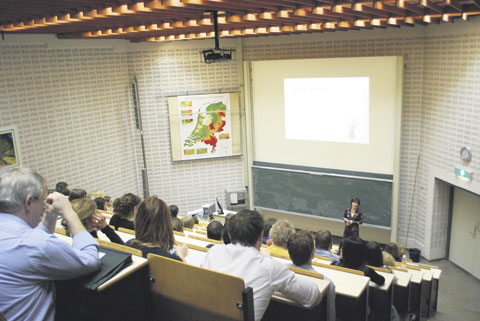
The 2nd National Science Communication Student Conference held at Utrecht University last month brought together more than 100 university students from all over the Netherlands to share inspiring experiences and career insights.
“It doesn’t happen every day that students get to meet other students or alumni from other universities who study or have studied in the same programme,” says Caroline Wehrmann, a lecturer in Science Communication at TU Delft, which was one of the organizers of this national conference. “We hope to bring science communication students, researchers and alumni together to share experiences and views on research and career options through discussions and networking.”
The conference started with the keynote speaker, Christine Critchley, senior lecturer in psychology from Swinburne University, Australia, who gave a presentation on how the commercialization of sciences impacts trust and public attitudes.
The subsequent discussions quickly became highly intense, and at one point, Anne Dijkstra, an assistant professor from the University of Twente, had to intervene to stop the debates from becoming overheated. It was clear however that the students attending the conference enjoyed the sizzling atmosphere.
Students from several universities then presented their internship projects, with topics ranging from scientific knowledge, and science and ideals, to TV shows. The session ended with a presentation by TU Delft’s ‘Crash Team’, a student consultancy team set up by science communication MSc students.
“For me the conference is a very nice way to gather information about recent science communication research and to meet students from other universities,” says Sander Clahsen, an MSc student from Twente. For Arend Jan Waarlo, a professor at Utrecht University, such conferences are also opportunities for the lecturers to see the differences in science communication education among various universities.
The conference’s most exciting segment began once several science communication alumni arrived: a science and technology magazine editor; corporate communication consultant; content manager; university science communicator; science communication researchers, and many others.
Esther Hamstra, a Utrecht University alumnus who currently works at Northern Lights, was fully equipped with her company’s portfolio and business cards. Within seconds she was surrounded by keen students attentively listening to her work experience stories.
“I really like talking to those who already work in the science communication field and hear their experiences,” says Floor Borlee, an MSc student from Groningen University.
The evening ended with networking in a relaxed setting, replete with inspiring stories and advice from the various alumni. So, even without business suits and CV checks, attending student conferences is definitely a fantastic way to expand one’s horizon and explore future careers.
Bedek de daken op de TU met mos, bepleit ir. Frederik de Wit. Het heeft alleen maar voordelen.
Frederik de Wit maakte op een conferentie in Londen kennis met het bedrijf Icopal, dat een bijzondere kleefstof had uitgevonden voor toepassing op daken. Veel daken, ook op de TU, zijn bedekt met bitumen – een soort teerlaag die in rollen verkrijgbaar is en die ter plekke versmolten moet worden. De nieuwe kleefstof op bitumenbasis hoeft niet verhit te worden en is niet giftig zodat het als basis kan dienen voor een moslaag over het dak.
De Wit, in het dagelijks leven werkzaam als onderzoeker aan het hechtingsinstituut, raakte erg gecharmeerd van het idee. Mos op het dak heeft alleen maar voordelen. Het isoleert de daken tegen hitte, kou en geluid. Het absorbeert de regen en voorkomt overstromingen bij hoosbuien. Mos neemt fijnstof en CO2 op uit de lucht en levert er in ruil zuurstof voor. Verder heeft het mos geen onderhoud nodig en doordat het geen wortels heeft, is er geen risico dat het ergens tussen groeit. Behalve daken zijn ook muren met mos te bekleden. Eigenlijk verbaast het De Wit dat zijn idee niet in de prijzen is gevallen. Zo mooi en zo toepasbaar. Een bestaande oplossing die al op de markt is. Misschien was juist dat het bezwaar.



Comments are closed.