
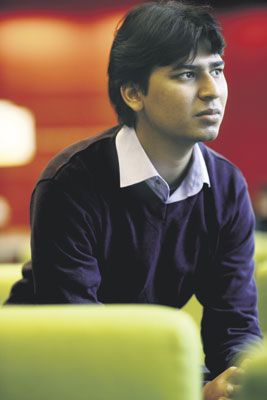
Vishwas Jain (23), a computer engineering student from India, was one of a select number of international students to win a prestigious HSP Christiaan Huygens scholarship, which he’ll use to fund his TU Delft MSc studies.
Only 150 winners from 1700 applicants for these Nuffic-sponsored scholarships. You clearly beat some pretty long odds. Why do you think you were selected as one of the Huygens scholarship winners?
“My undergraduate grades were quiet good, and I also did some good research projects which were funded by government of India. I also chose to work as a research engineer at my college. Beside my academic performance, I was very active in extracurricular activities during my undergraduate days. Apart from getting letter of recommendation from my professor in India, I also got a letter of recommendation from one professor at TU Delft. I also have one international publication to my name. The biggest forte I think though was my letter of motivation. So, my overall profile helped me to fetch this scholarship.”
What does an HSP Huygens scholarship mean to you?
“It means a lot to me. I hail from a middle-class Indian family, and like every other middle-class student I took an educational loan for my studies. The difference in living costs in Europe and India, along with the difference in value of currency, makes it a really difficult situation here. But now after getting the Huygens scholarship I can study without any financial stress, which leaves me with ample time to conduct my research work with proper time and interest.”
How does this scholarship affect your professional career? Is it a stepping stone to living and working in Netherlands or just an experience you’ll take back home with you to achieve something more in your home country?
“HSP Huygens is a very prestigious scholarship. This award brings me honor and also recognition. My Master’s degree is a milestone towards my long-term goal of pursuing a PhD. After finishing my studies I’d like to work in Netherlands for two to three years. I’d like to gain experience in this high-level research environment. After gaining this experience, I want to return to my country and, with my learning and experience gained in the Netherlands, promote good research work in India.”
What are the advantages of studying in Netherlands compared to India?
“The difference I think is found in the level of research in Netherlands compared to my country. The research work carried out at TU Delft is very impressive and also enticing. So, I believe my current motivation towards applied research will be strengthened by the TU Delft MSc programme. My cherished desire is to one day work in research and development, where not only can I work on challenging problems but also seek solutions to real world problems.”
What advice would you give to other students to achieve this scholarship?
“My first piece of advice to other students is to be honest in your letter of motivation. I think that good grades at TU Delft along with some research background are also very important to get selected.”
Having won this scholarship, do you now feel extra pressure to succeed and thus validate the selection committee’s belief in your abilities?
“I don’t feel burdened by any kind of expectation. At the time of the application process I was quite confident and optimistic I’d be nominated for the scholarship. I do the best I can from my side and strongly believe that things will automatically happen for me. An MSc degree from TU Delft will allow me to utilize my knowledge and expertise to serve my country.”
So do you know who this ‘Huygens’ guy is who is giving you all this free money?
“Sure, I know about Huygens. In fact we have a statue of Christiaan Huygens near entrance gate of our department. He was the Dutch scientist behind the telescope. He explained the wave nature of light.”
Huygens also believed in the existence of life on other planets. Do you?
“Yes, I believe in the existence of extraterrestrial life. This is fair possibility. Current discoveries suggest towards presence of water at Mars. This enhances the possibility of an existent life form.”
While studying for a BSc degree in chemical engineering in Iran, Mohammad Mahdi Barzmehri (25) was continuously frustrated by the lack of easily understandable books about the oil industry. His solution: write the book himself. Together with a fellow undergraduate student, he set about writing a book that would, he says, “tell the whole story of oil, and do so using familiar words that everyone can understand.”
Their book, entitled ‘Economics & Engineering in Oil Industries (Oil, Refining and Petrochemical)’, was published in July 2009 and has since won prestigious publishing prizes in Iran, including the national ‘Student Book of the Year Award’. The young authors are now hoping to publish their book in English. Barzmehri is currently an MSc student specializing in sustainable energy at TU Delft’s faculty of Applied Sciences.
Where does the background story of your book begin?
“As an Iranian you’re always hearing about oil issues in your daily life, starting in childhood, and I guess that affected me somehow. Then, while pursuing my BSc degree in chemical engineering, I decided to focus on different methods of gaining energy. Petrochemicals were a big part of these studies, yet it was really hard for us students to find information about the oil industry. We had to read several thick books just to get the smallest bits of information. That’s how we came up with the idea to write our book.”
And your user-friendly book was particularly targeted at students?
“Yes, we wanted to create a handbook, especially for students, and maybe for other interested individuals, that summarized all the books about oil in a logical way. Our book is like an academic textbook that provides the most basic knowledge about all aspects of oil.”
What are these aspects?
“The book starts with the upstream section of the oil industry and contains useful information about the origins of oil. After that the chapters explore drilling and different methods of oil recovery, introduce refinery and petrochemical processes and products, and finally conclude with oil-related financial information.”
Oil is of course a big issue in the Middle East. Did this fact inspire you as well?
“Petrol is Iran’s most important resource, and we have large reserves, but we don’t know how to use them well. We’re just using what we have now and forgetting to think about what will happen in future. Personally, I think solar energy could be a really good solution for Iran, since we have lots of sun, but nobody is currently considering this. Right now everything is about budget and income, and that’s why our book also focuses on the economic aspects of these energy issues.”
As BSc students, how did you gain sufficient knowledge to write an academic book?
“We read, studied and analyzed many books on the subject. We gathered all the useful information we could and put it in a clearly understandable order. One of our professors also guided us, but he only checked to ensure the technical information was correct.”
What was the most challenging part of creating a book?
“We did literally everything ourselves, from the simplest drawings to the most complex graphs. We had no experience in layout design, so we had some rough times with those software programs. Moreover, the language was challenging: Persian academic language, with all its technical terms, is hard to work with. We proofread and edited the book countless times before submitting to the publisher.”
Were people surprised that this book was actually written by BSc students?
“When we sent our book to the jury, they initially thought it was a PhD thesis, so were really surprised when they learned the truth. I was in Delft on the day we won the book award, but friends back home told me that we were profiled on TV and everyone was commenting on the success of two students who didn’t even have undergraduate degrees.”
Is your book famous now in Iran?
“It’s somehow famous among professionals: all the oil company people have read it and also professors. We hope students will start reading it as a quick way of studying for exams. Students are always looking for the least time-consuming ways to study, so they’ll love this book!”



Comments are closed.