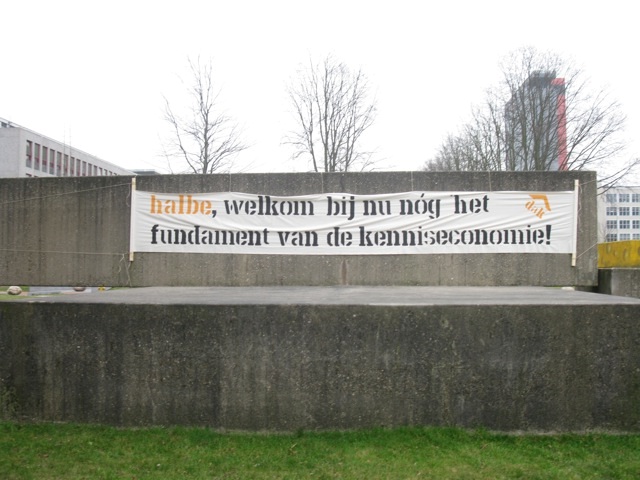
Staatssecretaris Halbe Zijlstra had vanmiddag op de TU Delft verwelkomd moeten worden door een spandoek van het Delftsch Aktie Komitee (DAK). Maar er was geen toestemming voor.
Filling up a fuel tank yourself will become a romantic relic of the past associated with big, roaring gasoline consuming automobiles. In future drivers will exchange their empty fuel tanks at a fuel station for new ones. And the tanks won’t be filled with gasoline, but rather with ammonia borane, a lightweight material that contains lots of hydrogen (19.6 weight percentage).
That is the vision presented by scientists at the Los Alamos laboratory in New Mexico (US). They believe that ammonia borane is the material that will help us get past our oil addiction.
Hydrogen can be stored efficiently in ammonia borane and when put in a solution that has some nickel-based catalyst added to it, the hydrogen can also easily be delivered from that material to energy-producing fuel cells. One of the remaining challenges however is to find a way to regenerate ammonia borane from the spent, dehydrogenated fuel. But in last week’s edition of the Science, US chemists describe a way to do just that. A 24-hour treatment with a rocket fuel, called hydrazine, in liquid ammonia at 40°C in a sealed pressure vessel puts all the hydrogen back in place.
The biggest bottleneck the researchers face now, they say, is the high price of hydrazine, which currently costs around 4.00 US dollars per kilo. But that price can drop fast, the researchers add, if the production process is scaled up, which of course would happen if the whole world is driving on ammonia borane instead of gasoline.
Professor Fokko Mulder, of the Fundamental Aspects of Materials and Energy section (Applied Sciences), who conducts research on magnesium hydrides as a hydrogen storage material, sees some other hurdles as well. Although he says that this research ‘certainly is an important step’, he’s far from convinced that we’ll all be driving on ammonia borane in the near future.
“The ammonia borane needs to be in a solution that will lower the effective hydrogen weight percentage,” he says.
Prof. Mulder also worries about toxic compounds: “How will the researchers prevent the chemical borane from being formed in the fuel tank during the release of hydrogen? They do not write about that. Borane is very bad for the fuel cell. And worse, if you hit a tree and your fuel tank rips apart, the toxic substance can be released in the environment.”
Professor Bernard Dam, of the Materials for Energy Conversion and Storage section (Applied Sciences), has similar reservations, yet these concern the ammonia which will also be produced. “They’ll have to add filters or invent some other complicated technique to prevent the ammonia from reaching the fuel cell and intoxicating it,” he opines.
Prof. Mulder also wonders how the Americans plan to deal with the catalyst that will still be present in the ‘empty’ fuel tank: “You have to remove that before you start the process to regenerate ammonia borane, since the catalyst counteracts this process. They may have worked out a way to do this in the laboratory, but if you do it on a much larger scale it becomes more complicated.”
En dus moest het spandoek weg voordat Zijlstra het had kunnen zien. Het enige wat rest, zijn een paar foto’s. De studenten voeren actie tegen de afschaffing van de studiefinanciering voor masterstudenten.
Op het spandoek stond de tekst: ‘Halbe, welkom bij nu nog het fundament van de kenniseconomie!’. De studenten zijn tegen Zijlstra’s plan om de studiefinanciering voor masterstudenten af te schaffen. Zij vinden dat bèta-studenten, wiens masteropleidingen twee jaar duren in plaats van één jaar, onevenredig hard door die bezuinigingsmaatregel getroffen worden.
In een persbericht schrijft het DAK dat ‘veel studenten zullen kiezen voor een niet-bètatechnische opleiding om zich geen dubbele studieschuld op de hals te halen’. “Door de afschaffing van de masterstudiefinanciering tast Halbe Zijlstra het fundament van de kenniseconomie aan.”
Halbe Zijlstra spreekt vanmiddag op het ‘Open Education Event’ in de aula. Het doel van die bijeenkomst, gericht op beleidsmakers in het Europese hoger onderwijs, is om meer bekendheid te geven aan het online beschikbaar stellen van onderwijsmateriaal.
Het Delftsch Aktie Komitee schrijft lange tijd op de achtergrond te hebben geopereerd. Nu vonden de studenten het nodig weer eens naar buiten te treden. Het DAK voerde ook al eens actie in de jaren negentig van de vorige eeuw. Het had toen zijn thuisbasis bij de Delftse studentenvakbond VSSD. Het DAK laat via de mail weten zelfstandig te opereren en niet gelieerd te zijn aan de VSSD.



Comments are closed.