

Credit the staff at the Dutch Consulate in Lagos with encouraging one young Nigerian international student to opt for TU Delft.
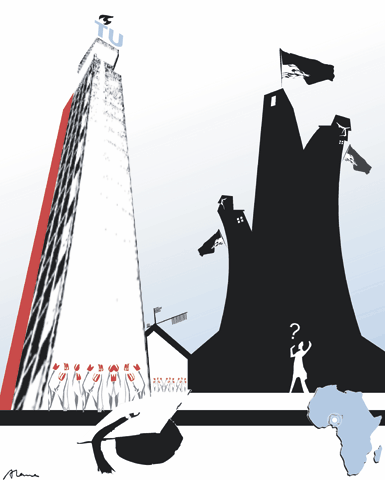
To one who does not know, a garden is a forest, an Ethiopian proverb reveals. The last two weeks of my life at home in Nigeria will forever remain most precious ones. I spent those days on the heels of the Netherlands Consulate in Nigeria, in search of an MVV Authorization of Temporary Residence. The process began on the July 3, when I visited the Dutch Consulate on Gana Street Maitama Abuja, there to submit my visa documents. At the gate, I met the security guards, who greeted me very politely. I was thoroughly amazed by this, and for a second I thought this was a ploy or I was daydreaming or in some sort of metaphysical trance. For the next few minutes I stood in awe, and to make sure I was not in the wrong place, I asked one of the guards again if indeed the door behind him led into the Netherlands Consulate?
Well, the long and short of this is that, like a man who has been bitten by a snake, I was skeptical of an old rope. Truth be told, the security men at the various embassies in Nigeria are very rude and disrespectful. Thus, going by all I’d experienced in the past, I didn’t expect to be treated courteously by the Dutch Consulate’s security guards, who also remained resolutely polite during my subsequent visits to the consulate. And as icing on this Dutch cake, the staffers inside attending to the visa applicants were no different: polite, courteous, encouraging and helpful in a natural way.
The great Nigerian writer Ben Okri once said, as writers it’s our moral onus to ask questions of reality, and so it is that I’m compelled to question the treatment we Nigerian students receive from the various embassies in my country. With the good treatment I received at the Dutch consulate, I’m left wondering why there is such a sharp contrast with other embassies. The very cold treatment I experienced at the British Visa Application Centre (VAC) earlier this year was not appreciated, and the VAC guards even lied to me, saying “the systems were down”, which barred my entry that day and meant I had to return the next day, thus costing me more money and huge inconvenience after travelling over 300km to submit my visa application.
I nevertheless took solace in the adage that, ‘in every disappointment there is a hidden blessing’, and picked myself up gracefully. The experience however greatly changed my perception of Britain and the British and I quickly decided against studying there, opting instead for the Netherlands, where student visas are arranged by the universities and are almost 100% guaranteed.
It is sad, but I also know of similar unpleasant, sometimes outright harsh, treatment at other embassies, including the American embassy. I also experienced rotten treatment at the Turkish embassy, where I went to submit a student visa application for my brother; they made us stand outside in the sun while only speaking to us through a tiny window in the gate. Why is it that these embassies treat Nigerians as if we are not humanly equal? It leaves me wondering, are some humans more equal than others?
It is certain little details, facts, experiences, such as those meted out by rude embassy staff, which leaves lasting impressions on people. I decided to study in the Netherlands, instead of Britain, due to my experiences and those of many of my friends. Statistics show that the UK makes many millions per year from international students, but with the visa policies they have in place, I believe such figures are sure to plummet, because Nigerians also contribute to these huge earnings, but are refused student visas for the most trifling reasons. The same applies to the Americans. Consequently, European universities are attracting more international students and the huge revenues they bring in.
An African saying is, ‘A hunter cannot scare a monkey with a dead baboon’, thus prospective students have started looking elsewhere to pursue their educations, so as not to be disappointed, discouraged, scared and emotionally wrecked by what I will call the unfair British American Student Visa Refusal Alliance! TU Delft begins in the various home countries of prospective international students, at the various Dutch consulates and embassies around the world, and the good treatment we receive there reflects nicely and vitally here on TU Delft.
To draw the curtain, we can only hope that ‘hope’, which is the pillar of the world, will provide us with a way out of problems such as these, so that we the young leaders of the future can be better exposed and equipped with the skills and know-how to develop our countries and salvage them from what British Prime Minister Gordon Brown (rather ironically given Britain’s unfair student visa policy) calls the greatest evils of our time: hunger, disease, famine, illiteracy and inequality.



Comments are closed.